Original Article: JRCRS. 2026:14(2): 98-104
7-Physical Activity during the Follicular Phase versus the Luteal Phase of the Menstrual Cycle among Eumenorrheic Females: A Cross-Sectional Study
Arooj Fatima1, Mehwish Khalid2, Hassan Bin Akram3, Zil e Huma4
1 4 Physical Therapist, Lahore College of Physical Therapy, Lahore, Pakistan
2 Assistant Professor, Lahore University of Biological and Applied Sciences, Lahore, Pakistan
3 Clinical Manager, Ghurki Trust and Teaching Hospital, Lahore, Pakistan
Full-Text PDF DOI: https://dx.doi.org/10.53389/JRCRS.2026140207
ABSTRACT:
Background: Fluctuations of hormones in the luteal and follicular phases of eumenorrheic women affect their physical activities in various aspects. Studies on these effects in eumenorrheic females, who experience regular menstrual cycles, remain limited. This study evaluates physical activity across these phases, contributing to personalized exercise recommendations and improved health outcomes.
Objective: To measure physical activity during the follicular phase vs the luteal phase of the menstrual cycle in eumenorrheic females.
Methodology: The research was a cross-sectional comparative study that assessed physical activity during the follicular and luteal phases of the menstrual cycle. The study included 40 women who had regular menstrual cycles, aged from 18 to 24. A non-probability purposive sampling technique was used. Physical activity measurement used the short version of the International Physical Activity Questionnaire (IPAQ-SF). Data analysis was conducted with SPSS version 26. The study variables were reported using descriptive statistics, including tables, graphs, and percentages.
Results: The comparison of the mean and standard deviation of the follicular phase and luteal phase was done. Studies revealed that participants achieved an average of 1147.98 total METS during the follicular phase with a SD of 14. 12, yet displayed an average total METS of 912.0375 along with an SD of 11.23 during the luteal phase.
Conclusion: The physical activity levels of eumenorrheic females were significantly higher during the follicular phase than during the luteal phase.
Keywords: Eumenorrheic, Follicular phase, Luteal phase, Menstrual cycle, Physical activity
Introduction:
Adolescence marks the start of menstruation, a natural physiological phase during which the endometrium of the uterus tears, causing blood loss and a variety of hormonal changes.1, 2 The period from the onset of one menstrual bleeding (menstruation) to the next in a fertile woman is known as the menstrual cycle (MC).3-7 Endocrine interactions of the hypothalamus, the pituitary gland, the ovaries, and the genital tract regulate the menstrual cycle.8-12 13 The female menstrual cycle is separated into follicular and luteal phases. The hormone progesterone aids in preparing the womb for the implantation of a growing embryo in the luteal phase, while the hormone estradiol, a form of estrogen released during ovulation, increases levels in the follicular phase, resulting in the development of an egg.14-18 The luteal phase typically averages around 13.3 days, whereas the follicular phase generally extends to approximately 15.7 days.19
Variations in endogenous hormones, particularly estrogen and progesterone, result in notable hormonal changes that influence various physiological systems, such as metabolism, muscle recovery, thermoregulation, cardiovascular function, and psychological well-being.11, 20-24
Eumenorrheic females refer to females who have an average menstrual cycle duration of 21 days to 35 days 25 and average bleeding that continues for 3-5 days.26 In eumenorrheic women, endogenous sex hormone levels can vary by more than 100% within 24 hours.27
Different approaches exist to define the comprehensive concept of physical activity. Humans engage in physical movement when they carry out actions and perform activities within culturally defined environments that are influenced by various interests, emotions, ideas, instructions, and relationships.26 A bodily movement that requires energy expenditure serves as the definition for physical activity (PA).28 Therefore, few studies quantified the habitual PA in women of reproductive age.29
Fluctuations of hormones in the luteal and follicular phases of eumenorrheic women affect their physical activities in various aspects. So, to determine how much physical activity is altered throughout different stages of the menstrual cycle, the International Physical Activity Questionnaire (Short form) is utilized. The International Physical Activity Questionnaire is now the most popular instrument for evaluating physical activity; the 9-item short form of the International Physical Activity Questionnaire (IPAQ-SF) evaluates physical activities according to four intensity categories: vigorous-intensity exercises, moderate-intensity exercises, walking activities, and sedentary conduct. The developers of the original version endorsed the “last 7-day recall” version of the IPAQ-SF for physical activity research monitoring purposes.30
The existing literature provides inconsistent findings regarding variations in habitual physical activity across different phases of the menstrual cycle in eumenorrheic women. While several studies have examined exercise performance and physiological responses across menstrual phases, limited research has specifically investigated differences in overall physical activity levels during the follicular and luteal phases. Understanding these variations is important for developing phase-specific exercise recommendations and optimizing individualized physical activity regimens. Therefore, the present study aims to compare physical activity levels during the follicular and luteal phases of the menstrual cycle among eumenorrheic females.
Methodology
After the approval of the research topic, a descriptive cross-sectional study was conducted over six months, from June 2023 to December 2023. The institute-level ethical requirements were followed, and the institutional Ethical Review Board of Lahore College of Physical Therapy, Lahore Medical and Dental College, granted ethical approval (Reference No: DPT/ERB/17). Data was collected from Lahore Medical and Dental College. The sample size was determined based on feasibility and reference to a previously published similar study involving eumenorrheic females assessing physical activity across menstrual cycle phases. Due to time constraints and availability of eligible participants within the study setting, a total of 40 participants who met the inclusion criteria were recruited using a non-probability purposive sampling technique.31 Subjects aged 18-24 years, Eumenorrheic females (21-45 days of cycle), unmarried females of Lahore Medical and Dental College, and those willing to provide consent forms were recruited for the study. Subjects with any history of systemic disease and recent trauma, on any type of contraceptives, and females with diagnosed PCOS and PCOD were not recruited for the study.
Each participant was only evaluated once between August and October 2023, via a scheduled face-to-face interview or an online survey. IPAQ served to evaluate physical activity among 40 eumenorrheic females.32 Physical activity during the last seven days is recorded through the 9-item short form (IPAQ-SF) across four intensity levels. The IPAQ-SF records these four types of physical activity: aerobic exercise, leisure riding, walking, and sitting activities. The “Metabolic Equivalent of Task (METs)s” of participants was determined following IPAQ criteria. We inquired about participants’ moderate and vigorous intensity activity time, as well as their walking time. The IPAQ criteria were used to calculate MET values for each subject. These were recorded as follows:
The calculation for walking MET minutes/week requires 3.3 times the walking minutes multiplied by the number of walking days.
The calculation for weekly moderate MET minutes involves multiplying 4.0 by the number of moderate-intensity activity minutes multiplied by the number of moderate days.
Energy MET minutes per week equals eight times the product of vigorous intensity activity minutes and vigorous intensity activity days.
The total number of MET minutes spent on physical activity each week equals the sum of walking MET minutes, combined with moderate MET minutes and vigorous MET minutes.33
Participants were selected according to the predefined inclusion and exclusion criteria. A detailed menstrual history was obtained, including average cycle length and the first day of the last menstrual period (LMP). Menstrual phase estimation was performed using the calendar method based on self-reported cycle length. The follicular phase was identified between days 5–9 of the menstrual cycle, and the mid-luteal phase was identified between days 19–23 in participants with regular cycles (21–35 days). Data on sociodemographic characteristics (age, body weight, body height, BMI) and clinical features like comorbidities were collected.
Data was analyzed using Statistical Package for the Social Sciences (SPSS) version 26.0. Categorical variables were summarized using frequencies and percentages. Continuous variables were expressed as mean and standard deviation. Descriptive statistics, including tables and graphical representations (histograms), were used to present the study findings.
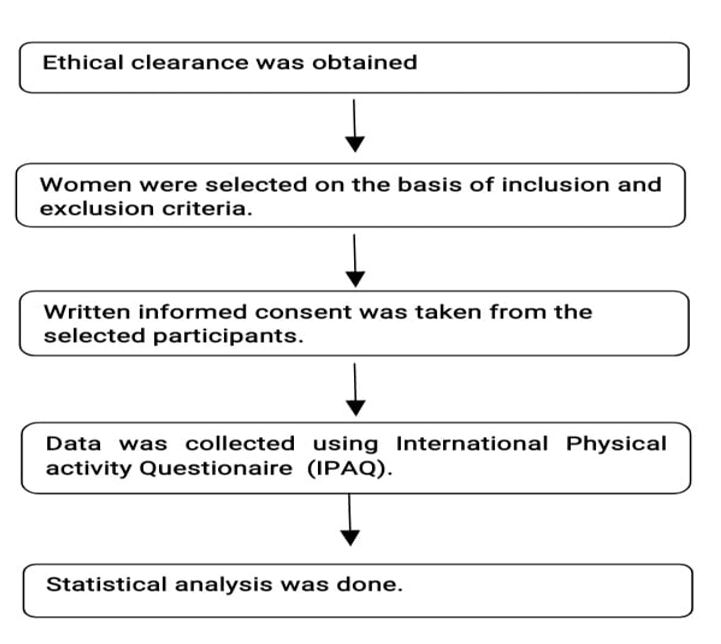
Flow Chart of the Procedure
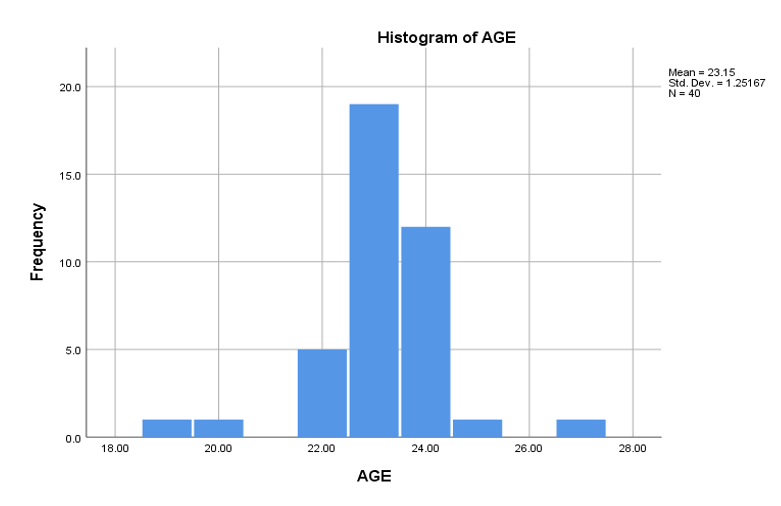
Figure 1: Descriptive Statistics of Age
Results
Histogram showing the age distribution of study participants (N = 40). Most participants were between 22 and 24 years of age, with a mean of 23.15 years and a standard deviation of 1.25.
Among the 80 participants, walking frequency varied across the menstrual cycle phases. A higher proportion of participants reported no walking during the luteal phase (27.5%) compared to the follicular phase (17.5%), whereas high-frequency walking (6–7 days/week) was more common in the follicular phase (32.5%) than the luteal phase (22.5%). Moderate activity (3–5 days/week) was slightly higher in the luteal phase (21.3%) than in the follicular phase (15%). These findings suggest a trend toward reduced walking activity during the luteal phase compared to the follicular phase. (Table 1)
The combined total METs (1030.01) indicate significant overall activity levels across all types of activities, with relatively low variability, suggesting consistency in activity patterns among participants. As the duration and intensity of physical activity increase (from 8 minutes to vigorous activities), the average MET values significantly rise. (Table 2)
The average of the follicular phase was 1147.98 with a standard deviation of 14.12. Conversely, the luteal phase was 912.03 with a standard deviation of 11.23. Follicular phase activity levels appeared higher than luteal phase activity levels based on data from eumenorrheic women.
| Table 1: No of days of Walking/Week | |||
| No. of Days of Walking/Week | Follicular Phase (n=40) | Luteal Phase (n=40) | Total (n=80) |
| No Walking | 7 (38.9%) | 11 (61.1%) | 18 (100%) |
| 1–2 Days of Walking | 8 (72.7%) | 3 (27.3%) | 11 (100%) |
| 3–5 Days of Walking | 12 (42.9%) | 17 (57.1%) | 29 (100%) |
| 6–7 Days of Walking | 13 (59.1%) | 9 (40.9%) | 22 (100%) |
| Total | 40 (50.0%) | 40 (50.0%) | 80 (100%) |
| Table 2: Total METS by Phase | |||
| METS | N | Mean | Std. Deviation |
| 8*Mins*Days/Week | 40 | 224.50 | 9.86 |
| 4*Mins*Days/Week | 40 | 272.50 | 6.54 |
| 3.3*Mins*Days/Week | 40 | 508.07 | 8.42 |
| VigorousMETS+ Moderate METS+Walking METS | 40 | 1030.01 | 13.76 |
| Table 3: Physical Activity in Phases of Menstrual Cycle | |||
| Phases of the Menstrual Cycle | N | Mean | Std. Deviation |
| Follicular Phase | 40 | 1147.98 | 14.12 |
| Luteal Phase | 40 | 912.03 | 11.23 |
| Total | 80 | 1030.01 | 13.34 |
Discussion
The research aimed to evaluate physical activity patterns between eumenorrheic women during their follicular and luteal menstrual cycle phases. The research outcomes demonstrated increased physical activity levels during the follicular phase when compared to the luteal phase. A recent research examination analyzed functional and sprint performance patterns between the luteal and the follicular phase of the menstrual cycle. Research was conducted through two testing sessions on days seven and twenty-one throughout a thirty-day menstrual cycle period with eumenorrheic women. Results showed that physically eumenorrheic women exhibited superior athletic ability while in the luteal phase, when compared to the follicular phase.31 The current study assessed physical activity patterns by measuring weekly METS in eumenorrheic women across the follicular and luteal phases. The results showed that physical activity levels were highest during the follicular phase (Mean METS = 1147.98 ± 14.12) compared to the luteal phase (Mean METS = 912.03 ± 11.23). The study showed that physical activity levels reached their peak during the follicular phase rather than during the luteal phase.
According to the Systematic Review and Meta-Analysis conducted in 2020, exercise performance reveals decreased levels during the early follicular phase among eumenorrheic women compared to other menstrual cycle stages. The study revealed that Eumenorrheic women demonstrated increased physical activity levels throughout their follicular phase when compared to their luteal phase.25 Research findings aligned with this investigation because eumenorrheic females exhibited higher physical activity throughout the follicular phase than during the luteal phase.
Another study was carried out in 2019, in which the association between the menstrual cycle and performance was investigated. The results of this study suggested that there was a probable drop in the performance of maximum resistance during the menstrual cycle’s LP, but this reduction was not detected in jumping and sprinting performances.14 The current study also found that eumenorrheic females may be less active during the luteal phase of the menstrual cycle than during the follicular phase.
A study tested functional performance in 13 young healthy women during different menstrual cycle stages through functional assessments. The research results showed that the functional tests,figure-8 Test for agility, speed, and coordination, the single hop test for lower limb strength, power, and balance, displayed varying performance levels across the three menstrual cycle phases, yet the modified star excursion balance test (mSEBT) scores remained consistent.34 These findings suggest that menstrual cycle phases influence certain aspects of physical function and activity. While balance-related abilities remain stable, overall physical activity and performance tend to be higher during the follicular phase, possibly due to hormonal and energy-level changes across the cycle. These findings are in line with a current study that physical activity levels during the various menstrual cycle phases varied significantly. The findings of the current study indicated that eumenorrheic females were more physically active during the FP than the LP.
The effect of regular exercise during menstruation on the length of the menstrual cycle in nullipara was investigated in a different study. Physically active women throughout menstruation, carrying out activity on a moderate level, are less likely to complain of symptoms of premenstrual syndrome (PMS) compared to those women who were only physically active out of menstruation and were non-physically active, which might suggest that moderate physical activity throughout menstruation precludes symptoms of premenstrual tension syndrome. According to the obtained results, it’s impossible to make a definite conclusion about the applicability of advocating moderate physical exercise, with a special focus on that during menstruation, for women.35 The current study showed that physical activity levels varied throughout the menstrual cycle, with higher activity observed during the follicular phase than the luteal phase, while the previous study concentrated on the effects of regular moderate exercise during menstruation on premenstrual symptoms. Together, these results demonstrate how various menstrual cycle phases affect physical activity behavior and reactions to exercise.
A research study examined exercise capacity through treadmill testing on non-active premenopausal women during different menstrual phases. Participating subjects performed exercise for longer durations (P < 0.05) while demonstrating better exercise capacity measurements (in MET) (P = 0.075) during the ML phase than the LF phase. Exercise capacity shows measurable variations between sedentary women during their different menstrual phases according to test results. Research suggests that females experience hormonal changes between the LF and ML phases that account for these observed variations.36 This study supports current research data, which demonstrates elevated physical activity levels during the follicular phase over the luteal phase among eumenorrheic women.
The study faced time-related limitations, which may have restricted the duration of participant monitoring and follow-up, potentially affecting the ability to capture long-term variations in physical activity across the menstrual cycle. Additionally, the sample size was limited, which could reduce the statistical power and generalizability of the findings to a broader population of young women. While questionnaires were used to assess physical activity due to their affordability and ease of implementation, this method relies on self-reported data and may introduce recall bias or inaccuracies compared to objective measures such as accelerometers. Despite these limitations, the study provides valuable insights into the relationship between menstrual cycle phases and physical activity patterns. Nonetheless, built-in limitations, such as recall bias from participants, can result in either an overestimation or underestimation of physical activity levels.
Recommendations: Based on the findings, it is recommended that women maintain regular physical activity throughout the menstrual cycle to support functional performance and overall well-being. Exercise programs may be tailored according to cycle phases, as activity tends to be higher during the follicular phase, while moderate activity during menstruation or the luteal phase may help alleviate premenstrual symptoms. Future research with larger samples and objective activity measures is warranted to establish evidence-based exercise guidelines for women across all menstrual cycle phases.
Conclusion
The study found substantial physical activity changes throughout different menstrual cycle periods. Studies confirmed that women with normal menstrual cycles experienced higher physical activity during their follicular stage compared to their luteal stage.
References
- Kulshrestha S, Durrani AM. Prevalence of menstrual disorders and their association with physical activity in adolescent girls of Aligarh city. Int J Health Sci Res. 2019;9(8):384-93.
- Carmichael MA, Thomson RL, Moran LJ, Wycherley TP. The impact of menstrual cycle phase on athletes’ performance: a narrative review. International journal of environmental research and public health. 2021;18(4):1667.
- Borlimi R, Riboli G, Nese M, Buattini M, Colombardo M, Brighetti G. Mind-Body Interactions Across the Menstrual Cycle Phases: A Systematic Review. OBM Integrative and Complementary Medicine. 2022;7(2):1-27.
- Liu KR, Lew LA, McGarity‐Shipley EC, Byrne AC, Islam H, Fenuta AM, et al. Individual variation of follicular phase changes in endothelial function across two menstrual cycles. Experimental Physiology. 2021;106(6):1389-400.
- Abo S, Smith D, Stadt M, Layton A. Modelling female physiology from head to toe: Impact of sex hormones, menstrual cycle, and pregnancy. Journal of Theoretical Biology. 2022;540:111074.
- Idoko LO, Okafor KC, Ayegba VO, Bala S, Evuka VB. Knowledge and practice of menstrual health and hygiene among young people in Jos, Plateau State, Nigeria. Open Journal of Obstetrics and Gynecology. 2022;12(4):292-308.
- MacGregor KA, Gallagher IJ, Moran CN. The relationship between insulin sensitivity and the menstrual cycle is modified by BMI, fitness, and physical activity in NHANES. The Journal of Clinical Endocrinology & Metabolism. 2021;106(10):2979-90.
- Klusmann H, Schulze L, Engel S, Bücklein E, Daehn D, Lozza-Fiacco S, et al. HPA axis activity across the menstrual cycle: a systematic review and meta-analysis of longitudinal studies. Frontiers in Neuroendocrinology. 2022;66:100998.
- Kamemoto K, Yamada M, Matsuda T, Ogata H, Ishikawa A, Kanno M, et al. Effects of menstrual cycle on appetite-regulating hormones and energy intake in response to cycling exercise in physically active women. Journal of Applied Physiology. 2022.
- Asarian L, Geary N. Sex differences in the physiology of eating. American Journal of Physiology-Regulatory, Integrative and Comparative Physiology. 2013;305(11):R1215-R67.
- Yadav TS, Pandey G. Impact of Menstrual Cycle Phases on the Selected Physiological Parameters and Skill-Related Components. Indian Journal of Physical Therapy and Research. 2022;4(2):109-13.
- Huang W-C, Chiu PC, Ho CH. The sprint-interval exercise using a spinning bike improves physical fitness and ameliorates primary dysmenorrhea symptoms through hormone and inflammation modulations: a randomized controlled trial. Journal of Sports Science & Medicine. 2022;21(4):595.
- Köse B. Analysis of the Effect of Menstrual Cycle Phases on Aerobic-Anaerobic Capacity and Muscle Strength. Journal of Education and Training Studies. 2018;6(8):23-8.
- Pisapia F, Senatore B, Fattore S. Correlation between menstrual cycle and performance. Journal of physical education and sport. 2019;19:1972-5.
- Kissow J, Jacobsen KJ, Gunnarsson TP, Jessen S, Hostrup M. Effects of follicular and luteal phase-based menstrual cycle resistance training on muscle strength and mass. Sports Medicine. 2022;52(12):2813-9.
- Lago-Fuentes C, Padrón-Cabo A, Fernández-Villarino M, Mecías-Calvo M, Muñoz-Pérez I, García-Pinillos F, et al. The follicular phase of the menstrual cycle is related to a higher tendency to suffer from severe injuries among elite female futsal players. Physical therapy in sport. 2021;52:90-6.
- Igonin P-H, Rogowski I, Boisseau N, Martin C. Impact of the menstrual cycle phases on the movement patterns of sub-elite women soccer players during competitive matches. International journal of environmental research and public health. 2022;19(8):4465.
- Shrestha R, Yadav BP, Shrestha E, Manna S. Effect of Different Phases of Menstrual Cycle on Cardio-Respiratory Efficiency in Normal, Overweight, and Obese Female Undergraduate Students: An Original Research. Indian Journal Of Basic and Applied Medical Research. 2021;10(4):228-35.
- Schmalenberger KM, Eisenlohr-Moul TA, Jarczok MN, Eckstein M, Schneider E, Brenner IG, et al. Menstrual cycle changes in vagally-mediated heart rate variability are associated with progesterone: evidence from two within-person studies. Journal of Clinical Medicine. 2020;9(3):617.
- de Jonge XAJ. Effects of the menstrual cycle on exercise performance. Sports medicine. 2003;33:833-51.
- Mihm M, Gangooly S, Muttukrishna S. The normal menstrual cycle in women. Animal reproduction science. 2011;124(3-4):229-36.
- Oğul A, Ercan S, Ergan M, Parpucu Tİ, Çetin C. The effect of menstrual cycle phase on multiple performance test parameters. Spor Hekimliği Dergisi. 2021;56(4):159-65.
- Nabo J, Conceição A, Parraca JA, Tomas-Carus P, Batalha N. Comparison of cardiorespiratory resistance in different menstrual cycle phases in female futsal players. Apunts Sports Medicine. 2021;56(209):100341.
- Innocent M, Donné A, Marc B, God L, Ghislain A. Influence of the Menstrual Cycle on the Performance of Different Physical Tests Specific to Handball. Int J Sports Exerc Med. 2022;8:234.
- McNulty KL, Elliott-Sale KJ, Dolan E, Swinton PA, Ansdell P, Goodall S, et al. The effects of menstrual cycle phase on exercise performance in eumenorrheic women: a systematic review and meta-analysis. Sports medicine. 2020;50:1813-27.
- Xiping L, Xiaqiu W, Lirong B, Jin P, Ka-Kit H. Menstrual cycle characteristics as an indicator of fertility outcomes: evidence from a prospective birth cohort study in China. Journal of Traditional Chinese Medicine. 2021;42(2):272.
- Bruinvels G, Hackney AC, Pedlar CR. Menstrual cycle: the importance of both the phases and the transitions between phases on training and performance. Sports Medicine. 2022;52(7):1457-60.
- Chen CY, Kawabe R, Morino S, Nagai-Tanima M, Aoyama T, Mukaiyama K, et al. The Relationship Between Physical Activity and Premenstrual Syndrome in Female College Students. 2022.
- Kroll-Desrosiers AR, Ronnenberg AG, Zagarins SE, Houghton SC, Takashima-Uebelhoer BB, Bertone-Johnson ER. Recreational physical activity and premenstrual syndrome in young adult women: a cross-sectional study. PloS one. 2017;12(1):e0169728.
- Lee PH, Macfarlane DJ, Lam TH, Stewart SM. Validity of the international physical activity questionnaire short form (IPAQ-SF): A systematic review. International journal of behavioral nutrition and physical activity. 2011;8:1-11.
- Borkar K, Borkar P. Analysis of physical performance during the follicular phase vs the luteal phase of the menstrual cycle in eumenorrheic and young women. Age. 2022;21(0.79).
- Kolić PV, Sims DT, Hicks K, Thomas L, Morse CI. Physical activity and the menstrual cycle: A mixed-methods study of women’s experiences. Women in Sport and Physical Activity Journal. 2021;29(1):47-58.
- Lee PH, Macfarlane DJ, Lam TH, Stewart SM. Validity of the international physical activity questionnaire short form (IPAQ-SF): A systematic review. International journal of behavioral nutrition and physical activity. 2011;8(1):115.
- Kami AT, Vidigal CB, Macedo CdSG. Influence of menstrual cycle phases in functional performance of healthy and young women. Fisioterapia e Pesquisa. 2017;24:356-62.
- Szpak A. Influence of moderate physical activity, including physical activity during menstruation, on the course of the menstrual cycle among nullipara—an attempt to evaluate. Health Promotion & Physical Activity. 2021;16(3):1-6.
- Yazar S. The effect of menstrual cycle phase on exercise capacity measured by treadmill exercise test. Turkish Journal of Sport and Exercise. 2015;17(1):12-5.