Original Article: JRCRS. 2026:14(2): 85-91
5-Frequency of hallux valgus deformity among university students: A Cross-Sectional Study
Hafsah Arshad1, Hafsah Gul Khattak2, Faiqa Shafaq3, Zoha Irfan4, Maria Ejaz5
1 Assistant Professor, Ibadat International University, Islamabad, Pakistan
2 Senior Lecturer, Ibadat International University, Islamabad, Pakistan
3 Consultant Physiotherapist, Islamabad Physiotherapy and Rehabilitation Centre, Islamabad, Pakistan
4 Clinical Physiotherapist, Shifa Neuro Clinic, Rawalpindi, Pakistan
5 Physiotherapist, Transition Therapy Centre, Islamabad, Pakistan
Full-Text PDF DOI: https://dx.doi.org/10.53389/JRCRS.2026140205
ABSTRACT:
Background: Hallux valgus is common forefoot deformity which involves lateral deviation of the big toe and medial deviation of the first metatarsal. HV results in altered foot biomechanics causing pain and functional limitations. It may develop due to prolong weight bearing, fashion foot wear choices, improper shoes or genetic predisposition in young people.
Objective: To find out the frequency of hallux valgus deformity and examine its association with different factors among university students.
Methodology: The descriptive cross-sectional study was conducted from February 2022 to July 2022. The study included 340 volunteer university students of 18-26 years’ age. The sample size was raised using non-probability convenient sampling technique. Data was collected by using a semi-structured questionnaire which includes self-reported Manchester scale for Hallux valgus, Numeric pain rating scale (NPRS) and questions related to family history and footwear. Those who were having any congenital foot deformity, previous injury e.g., foot fracture, surgery and co morbidities like diabetes, rheumatoid arthritis, and gout were excluded from study. Informed consent was taken from each participant. Data was analyzed by SPSS version 26.
Results: The mean age of participants was 22.04±1.65 years. The overall frequency of Hallux valgus was 30.3% (n=103). Bilateral HV was noted in 61.0% (n=63) of participants. Among male participants 25.3% (n=42) had mild and 5.4% (n=9) had moderate HV while in females 16.0% (n=28) had mild and 2.3% (n=4) had moderate HV. HV was more prevalent in male participants with significant association of male footwear (p=0.002). There was a significant association of big toe pain (p=0.003) with HV.
Conclusion: The frequency of hallux valgus was 30.3% among university students. It was more frequent in male students. Special attention should be given to footwear and big toe pain among such cases for early prevention of HV.
Keywords: Hallux Valgus, Bunion, Foot, Deformities, University Students
Introduction:
Hallux valgus, also known as bunion, is one of the common deformities of foot. It is manifested as the medial deviation of first metatarsal head and lateral deviation of proximal phalanx of first metatarsal. It is the most recognizable foot deformity in medical practice.1-3 Due to big toe deformity the 1st metatarsal protrudes out in hallux valgus deformity. Shoes may induce external stimulation that causes inflammation, redness, and edema. Furthermore, it compresses adjacent nerves which cause numbness and pain in the foot. The hallux valgus deformity may develop gradually due to ground reactive forces. The development of hallux valgus deformity is also influenced by dynamic muscle stresses across the first MTP joint.4 Hallux valgus is a serious disabling medical condition that needs to be treated to slow the progression of deformity. There is marked decline in foot specific and overall quality of life of an individual due to severity of hallux valgus.5
Considering biomechanical causes of hallux valgus, studies reported that increase pressure under big toe, more outward position of rare foot or greater calcaneal stance position, increase pressure for longer period and altered pressure under forefoot area were found to be associated with hallux valgus.6 HV is a complex deformity and there is no clear etiology identified for the high prevalence of Hallux valgus in females compared to men. The changes in skeletal geometry, ligament laxity of first proximal phalanx was found to be significant factor for development of Hallux valgus deformity.7, 8 Perera et al suggested that genetic predisposition, poor-fitting or high heeled shoes, disproportionate weight bearing, differences between gender and racial background ere the several potential etiological factors.9 Pain is the most typical symptom of Hallux valgus. Some other symptoms are balance and gait disorder that also lead to fall in older adults.10 Generally, hallux valgus is diagnosed by foot radiographs, when the angle between proximal phalanx and 1st meta-tarsals found to be greater than 15 degrees.11 Evaluation of Hallux valgus with the radiograph is however not always practical. Alternative methods have been proposed like use of goniometer, measuring foot girth, using standard photos or drawing lines.12 The Manchester scale 13 and a line drawing tool as described by Roddy et al. 14 are the most advanced of these instruments. The Manchester scale has four classes of Hallux Valgus that are: none, mild, moderate, and severe utilizing photos of foot. The reliability of the Manchester scale for grading Hallux Valgus has been demonstrated to be excellent, with kappa values of 0.77 for re-test reliability and 0.86 for inter-tester reliability. 13 A meta-analysis consisting of 78 papers revealed that the prevalence of Hallux valgus was 23% in adults between the age of 18 and 65 years. The prevalence of older people over 65 years was 35.7%. Female has higher prevalence when compare to males and it was also observed that Hallux valgus tends to be more prevalent with increasing age.15 According to a study in China, HV with various degrees was reported in 36.5 % females. They also found that family history was related to prevalence of hallux valgus in females.16 Hallux valgus (HV) is a progressive foot deformity affecting the first metatarsophalangeal (MTP) joint, often leading to significant functional disability and foot pain. While numerous studies have investigated the development of hallux valgus, in larger age groups or on single gender. Research specifically examining the student population, types of footwear, and duration of shoe wear has been limited. The primary objective of current study was to find out frequency of hallux valgus among university students and comparison between male and female. The secondary objective was to find out the associated factors of hallux valgus.
Methodology
A descriptive cross-sectional study was carried out from February 2022 to July 2022 at Ibadat International University Islamabad. The ethical approval was taken from Ethical Review Board of the university under Ref no (IRB-IIUI-FAHS/DPT/1020-1205) The duration of study was six months after the approval of synopsis. University students of age between 18 to 26 years, both gender and willing to participate were included in the study. Those who were having any congenital foot deformity, previous injury e.g., foot fracture, surgery and co morbidities like diabetes, rheumatoid arthritis, and gout were excluded from study. Written informed consent was taken from each participant. The sample size was calculated using Slovin’s formula n = N / (1 + N e2) taking confidence interval 95% and margin error (e) 5% or 0.05. The actual population was taken N= 3000, so the sample turned out to be 352. After applying inclusion and exclusion criteria, 12 were excluded, 340 participants were sample for study. Non- probability sampling technique was used for collection of data. The data was collected using a semi-structured questionnaire. Briefly, the first part of the questionnaire was demographic data (age, gender, weight, height, department, semester). The second part in the questionnaire is the self-evaluation of hallux valgus through Manchester scale. This scale was used to determine the prevalence of hallux valgus. It comprised of four pictures showing no deformity, mild deformity, moderate deformity and severe deformity.8 The third part included questions about foot pain by using numeric pain rating scale (NPRS), which was to measure intensity of their pain as none (0), mild (1-3), moderate (4-6) and severe (7-10). The fourth part of the questionnaire determined the familial history contributing to the hallux valgus deformity. The last part included questions about footwear choices in which both genders were shown pictures of standard shoe types (heels, flat, sneakers, kheri, oxford, pumps and narrow toe box shoes) for them to recognize the type they most commonly use and duration for which they continuously wore the shoes in a day and in the week.
Data was analyzed by using SPSS version 26. Descriptive statistics were applied. For quantitative variable mean and standard deviation and for qualitative variables frequency and percentages were calculated. Chi-square test of Independence was used to find out the association between age, Gender, BMI, pain. If p-value was less than 0.05, the data was considered statistically significant.
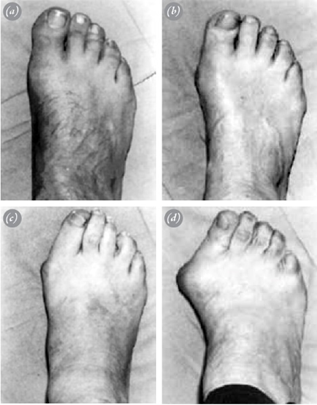
Figure 1: Manchester scale
Results
The mean age of participants was 22 ± 1.65 (range 18-26 years). Out of 340 participants there were 166 (48.8) males and 174 (51.2) females. The mean height in m2 of the participants was 2.78 ± 0.315, the mean weight was 60.89 ± 12.53 kg, and the mean BMI was 21.9 ± 3.84 kg/m2. According to BMI classification, most of the participants were of ideal weight 221(65.0%), 53(15.6%) were underweight, 51(15.0%) were overweight and 15(4.4 %) were obese. Around 26 % of study participants (n=88) reported having a family member with Hallux valgus. Mothers 12.1% (n= 41) were mostly affected, followed by father 6.2% (n=21), uncle/ aunt 3.5% (n=12), paternal grandmother 2.1% (n=7) and maternal grandmother 2.1% (n=7). The participants reported that there was only one family member who was affected by Hallux valgus. The overall frequency of Hallux valgus was 30.3% (n = 103). Bilateral HV was noted in 61.2% (n = 63), right foot 12.6% (n=13) and left foot 26.2% (n=27). Characteristic of Manchester Scale and big toe pain and details of footwear among participants were given in Table 1.
Comparison between gender showed that male participants, 25.3% (n=42) had mild and 5.4% (n=9) had moderate HV and in females 16.0% (n=28) had mild and 2.3% (n=4) had moderate HV. Detailed comparison among participants was given in Table 2. There was a significant association between big toe pain and hallux valgus with (p=0.003). Hallux valgus was frequent in males with a significant association of (p=0.002) with male footwear. Moreover, there was no significant association between female footwear and HV, but in females who wore narrow toe boxes (heels and flats) had higher prevalence of HV as compared to females who wore wide toe boxes (heels and flats). Shoe wearing hours per day and days per week did not show any significant association with HV. BMI and family history did not show any significant association with the development of HV. (Table 3).
| Table 1: Characteristic of Manchester Scale and Big Toe Pain and details of Footwear among participants | |
| Variables | N (%) |
| Manchester scale Right foot
Normal Mild Moderate |
264 (77.6)
73 (21.5) 3 (0.9) |
| Manchester scale Left foot
Normal Mild Moderate |
250 (73.5)
68 (20.0) 22 (6.5) |
| BIG TOE PAIN
Yes No |
58 (17.1)
282 (82.9) |
| Gender
Male Female |
32 (9.41)
26 (7.64) |
| Severity of pain
Mild Moderate Severe |
26(7.6)
27(7.9) 5(1.5) |
| Big toe pain frequency
Rarely Sometimes Always |
20 (5.9)
38 (11.2) 0 (0.0) |
| Big toe pain timing
At rest During night During walking During exercise Other activities |
6 (1.8)
5 (1.5) 33 (9.7) 6 (1.8) 8 (2.4) |
| Footwear (Male)
Round toe-box Pointed/elongated Wide toe-box Squared toe-box Narrow toe-box |
26 (7.6)
14 (4.1) 85(25.0) 10(2.9) 31(9.1) |
| Footwear (Female)
High heels with narrow toe-box High heels with wide toe-box Flat with narrow toe-box Flat with wide toe-box |
15(4.4)
10(2.9) 64(18.8) 85(25.0) |
| Hours in a day
5-6 hours 6-7 hours 7-8 hours >8 hours |
135(39.7)
90(26.5) 82(24.1) 33(9.7) |
| Days in a week
Daily Rarely Sometimes Never |
234(68.8)
28(8.2) 73(21.5) 5(1.5) |
| Table 2: Comparison between male and female participants | ||
| Variable | Male (n=166) | Female (n=174) |
| Age
18-20 21-23 24-26 |
18 (10.8)
109 (65.7) 39 (23.5) |
35 (20.1)
119 (68.4) 20 (11.5) |
| BMI categories
Underweight Normal Overweight Obese |
17 (10.2)
101 (60.8) 37 (22.3) 11 (6.6) |
36 (20.7)
120 (69.0) 14 (8.0) 4 (2.3) |
| Manchester scale
None Mild Moderate |
115 (69.3)
42 (25.3) 9 (5.4) |
142 (81.7)
28 (16.0) 4 (2.3) |
| Family history
Mother Father Paternal grandmother Maternal grandmother Uncle/aunt None |
21 (12.7)
12 (7.2) 4 (2.4) 3 (1.8) 4 (2.4) 122 (73.5) |
20 (11.5)
9 (5.2) 3 (1.7) 4 (2.3) 8 (4.6) 130 (74.7) |
| Table 3: Association of Hallux valgus | ||||
| Variable | Hallux valgus | X2 | p-value | |
| n = 103
Yes |
n = 237
No |
|||
| Age
18-20 21-23 24-26 |
11 (20.8)
70 (30.7) 22 (37.3) |
42 (79.2)
158 (69.3) 37 (62.7) |
3.669 | 0.160 |
| Gender
Male Female |
58 (34.9)
45 (25.9) |
108 (65.1)
129 (74.1) |
3.315 | 0.069 |
| BMI
Underweight Normal Overweight Obese |
19 (35.8)
68 (30.8) 14 (27.5) 2 (13.3) |
34 (64.2)
153 (69.2) 37 (72.5) 13 (86.7) |
3.037 | 0.386 |
| Big toe pain
Yes No |
27 (46.6)
76 (27.0) |
31 (53.4)
206 (73.0) |
8.753 | 0.003*** |
| Family history
Yes No |
32 (36.4)
71 (28.2) |
56 (63.6)
181 (71.8) |
2.071 | 0.150 |
| Male footwear
Round toe box Pointed/elongated Wide toe box Squared toe box Narrow toe box |
17 (65.4)
6 (42.9) 22 (25.9) 4 (40.0) 9 (29.0) |
9 (34.6)
8 (57.1) 63 (74.1) 6 (60.0) 22 (71.0) |
19.079 | 0.002*** |
| Female footwear
High heels, narrow toe box High heel, wide toe box Flat, narrow toe box Flat, wide toe box |
5 (33.3)
3 (30.3) 18 (28.1) 19 (22.4) |
10 (66.7)
7 (70.0) 46 (71.9) 66 (77.6) |
4.444 | 0.349 |
| Hours per day
5-6 hours 6-7 hours 7-8 hours >8 hours |
42 (31.1)
33 (36.7) 22 (26.8) 6 (18.2) |
93 (68.9)
57 (63.3) 60 (73.2) 27 (81.8) |
4.532 | 0.209 |
| Days per week
Daily Rarely Sometimes Never |
73 (31.2)
8 (28.6) 19 (26.0) 3 (60.0) |
161 (68.8)
20 (71.4) 54 (74.0) 2 (40.0) |
2.848 | 0.416 |
Discussion
The current study aimed to find the frequency of hallux valgus and associated factors for the deformity. The overall frequency of hallux valgus was 30.3%. The deformity was found to be more prevalent in male students. Big toe pain and footwear were found to be associated with HV. Daniel et al in their study, used a self-structured questionnaire for 1056 females to find prevalence and explore whether high were associated with Hallux valgus deformity. The results revealed that 36.5% Chinese females had HV. Among them 29% with mild complaints of HV, almost 5% with moderate and 2.2% had severe HV deformity. Moreover, compared to their younger counterparts, females over 40 years of age showed a greater injury prevalence (p <0.01). Females who frequently wore high-heeled shoes and had a family history of hallux valgus were 26 times (RR=26) more likely to acquire hallux valgus than those who did not.16 Nery in their study to analyze hallux valgus deformity in male considering demographic and etiological concerns, reported that Hallux valgus in males was often hereditary, predominantly transmitted through the maternal line, with an earlier onset and greater severity compared to females. They observed that female-to-male ratio was 15:1. The primary intrinsic factor associated with hallux valgus in males was a high distal metatarsal articular angle.17 Gonalez Martin et al reported 39% prevalence of hallux valgus. The study suggested that hammer toe, flat feet, gender and increasing age were associated with hallux valgus. It was also observed that Hallux valgus was linked to reduced quality of life as well as increases in foot discomfort, disability and difficulty in performing functional tasks of daily living.18. Almost 76 (27 %) participants reported HV without big toe pain. This finding is supported by previous study by Cho et al in Korea, which was determined to find prevalence and associated factors of hallux valgus between age 20-69 years.19 Owoeye et al documented the prevalence of Hallux valgus in young population of Lagos to be 15.4%. There were 43.6% male and 56.4 % female participants in their study. They also found that bilateral hallux valgus was present in 3.7 % participants, 5.9% had left foot and 5.8% had right foot HV. Hallux valgus was more common female, and its prevalence was found to be linked with increasing age. HV among participants resulted in inability to walk and stand for extended period of time in 9.3% and 14% respectively.20 Alkhaibary et al in their work found that Hallux Valgus was prevalent in 43% participants. The study included 140 males and 280 females. The prevalence across gender was found to be 30.7% in male and 49.2% in females. Hallux valgus was associated with female gender, pain in big toe and a family history of H.21 In another cross-sectional survey conducted by Okeke, HV was reported in 12.9 % study population. It was present in 11.2% female and 14.3% males. Bilateral hallux valgus was present in 5.5% persons. The results were to our results that HV more prevalent in male participants and its prevalence was found to increase with increasing age.22 Nguyen et al in their study on exploring risk factors associated with hallux valgus in population reported that 25% men and 58%women were found with HV. High heel and low BMI between 20-64 years of was found to be associated with HV in women, whereas flatfoot and high BMI were reported to be associated in men with HV.10 The study in North Staffordshire, UK, found 30.4% prevalence of Hallux valgus in 1482 participants. Among them 743 were men and 739 were women. Over the course of seven years, the incident hallux valgus affects 1 in 5 persons over the age of fifty. It is associated with advanced age, deteriorating physical health, foot pain, and a history of wearing constrictive footwear. They also concluded that alignment changes in the first metatarsophalangeal joint may continue to happen after the age of fifty.2
Hallux valgus is not limited to older adults and is prevalent among university students. Early identification of HV can prevent progression to pain and severe functional limitations. The association between hallux valgus and footwear among male students, highlight the need for awareness programs regarding footwear choices. Nonprobability convenient sampling technique was used, which limit the generalizability of results. Additionally, the severity of hallux valgus was found through self-reported Manchester scale rather than any radiographic assessment which may affect the accuracy of measurement. It was a cross-sectional study design, and causal relationships could not be established. Future researchers should consider conducting probability sampling techniques including multicenter larger samples. It is also recommended to conduct longitudinal study to observe progression of HV in young adults over time.
There are several limitations in the study, sample size was small, and it was a conducted in one setting. The study did not consider certain factors, like ligamentous laxity, shape of metatarsal head and first metatarsal length. Furthermore, the current study did not measure the exact angles for the severity of deformity and pes-planus was not taken into consideration. Future studies must be conducted with large sample size and hallux valgus severity must be assessed through radiograph.
Conclusion
The overall frequency of hallux valgus was 30.3%. Hallux valgus was more frequent among male university students. Big toe pain was associated with HV. No statistically significant association could be found between HV, BMI, female footwear, family history, and duration of footwear worn.
References
- Okuda H, Juman S, Ueda A, Miki T, Shima M. Factors related to prevalence of hallux valgus in female university students: a cross-sectional study. Journal of epidemiology. 2014;24(3):200-8.
- Menz HB, Marshall M, Thomas MJ, Rathod‐Mistry T, Peat GM, Roddy E. Incidence and progression of hallux valgus: a prospective cohort study. Arthritis Care & Research. 2023;75(1):166-73.
- Çiçek F, Kurtoğlu Olgunus Z, Koç T. The effect of hallux valgus on the anatomy of the nerves around the first metatarsal bone. Surgical and Radiologic Anatomy. 2024;46(4):433-41.
- Easley ME, Trnka H-J. Current concepts review: hallux valgus part 1: pathomechanics, clinical assessment, and nonoperative management. Foot & ankle international. 2007;28(5):654-9.
- Menz HB, Roddy E, Thomas E, Croft PR. Impact of hallux valgus severity on general and foot‐specific health‐related quality of life. Arthritis care & research. 2011;63(3):396-404.
- Martínez-Nova A, Sánchez-Rodríguez R, Pérez-Soriano P, Llana-Belloch S, Leal-Muro A, Pedrera-Zamorano JD. Plantar pressures determinants in mild Hallux Valgus. Gait & posture. 2010;32(3):425-7.
- Morales-Orcajo E, Bayod J, Becerro-de-Bengoa-Vallejo R, Losa-Iglesias M, Doblare M. Influence of first proximal phalanx geometry on hallux valgus deformity: a finite element analysis. Medical & Biological Engineering & Computing. 2015; 53:645-53.
- Taniguchi A, Tanaka Y. Hallux Valgus. Orthopaedic Sports Medicine: An Encyclopedic Review of Diagnosis, Prevention, and Management: Springer; 2023. p. 1-10.
- Perera A, Mason L, Stephens M. The pathogenesis of hallux valgus. JBJS. 2011;93(17):1650-61.
- Nguyen U-S, Hillstrom HJ, Li W, Dufour AB, Kiel DP, Procter-Gray E, et al. Factors associated with hallux valgus in a population-based study of older women and men: the MOBILIZE Boston Study. Osteoarthritis and cartilage. 2010;18(1):41-6.
- Hardy R, Clapham J. Observations on hallux valgus. The Journal of Bone & Joint Surgery British Volume. 1951;33(3):376-91.
- Panchbhavi VK, Trevino SG. Evaluation of hallux valgus surgery using computer-assisted radiographic measurements and two direct forefoot parameters. Foot and ankle surgery. 2004;10(2):59-63.
- Garrow AP, Papageorgiou A, Silman AJ, Thomas E, Jayson MI, Macfarlane GJ. The grading of hallux valgus: the Manchester Scale. Journal of the American Podiatric Medical Association. 2001;91(2):74-8.
- Roddy E, Zhang W, Doherty M. Validation of a self-report instrument for assessment of hallux valgus. Osteoarthritis and Cartilage. 2007;15(9):1008-12.
- Nix S, Smith M, Vicenzino B. Prevalence of hallux valgus in the general population: a systematic review and meta-analysis. Journal of foot and ankle research. 2010; 3:1-9.
- Wu D, Louie L. Does wearing high-heeled shoe cause hallux valgus? A survey of 1,056 Chinese Females. The Foot and Ankle Online Journal. 2010;3(5):3.
- Nery C, Coughlin MJ, Baumfeld D, Ballerini FJ, Kobata S. Hallux valgus in males—part 1: demographics, etiology, and comparative radiology. Foot & ankle international. 2013;34(5):629-35.
- González-Martín C, Alonso-Tajes F, Pérez-García S, Seoane-Pillado MT, Pértega-Díaz S, Couceiro-Sánchez E, et al. Hallux valgus in a random population in Spain and its impact on quality of life and functionality. Rheumatology international. 2017; 37:1899-907.
- Cho N, Kim S, Kwon D-J, Kim H. The prevalence of hallux valgus and its association with foot pain and function in a rural Korean community. The Journal of Bone & Joint Surgery British Volume. 2009;91(4):494-8.
- Akinbo S, Aiyegbusi A, Owoeye O, Ogunsola M. Prevalence of hallux valgus among youth population in Lagos, Nigeria. Nigerian Postgraduate Medical Journal. 2011;18(1):51-5.
- Alkhaibary A, Alghanim F, Najdi A, Alanazi K, Alkenani NS. Hallux valgus in Riyadh, Saudi Arabia: Prevalence, characteristics, and its associations. Journal of Musculoskeletal Surgery and Research. 2019; 3:292.
- Okeke CM, Ukoha UU. Prevalence of hallux abducto valgus among various groups in anambra state of nigeria; Predominio de hallux abducto valgus entre varios grupos en el estado de anambra de Nigeria. Revista Argentina de Anatomía Clínica. 2017;9(2):52-7.